 Ethanfel
5f29b225b7
Ethanfel
5f29b225b7
ComfyUI nodes for UniverSR (ICASSP 2026) — vocoder-free audio
super-resolution (8/12/16/24 kHz → 48 kHz) via flow matching.

- UniverSR Model Loader: presets auto-download to models/universr,
  plus local dir / raw .pth (from_local) loading, with caching.
- UniverSR Super-Resolution: chunked overlap-add for long audio,
  per-channel stereo, seed control with global-RNG isolation,
  wet/dry blend, and an optional before/after spectrogram.
- Vendors the universr inference package under vendor/ (prefers an
  installed copy); only extra dep beyond ComfyUI's stack is torchdiffeq.

Co-Authored-By: Claude Opus 4.8 <noreply@anthropic.com>
109 lines
5.0 KiB
Markdown
109 lines
5.0 KiB
Markdown
# ComfyUI-UniverSR
|
||
|
||
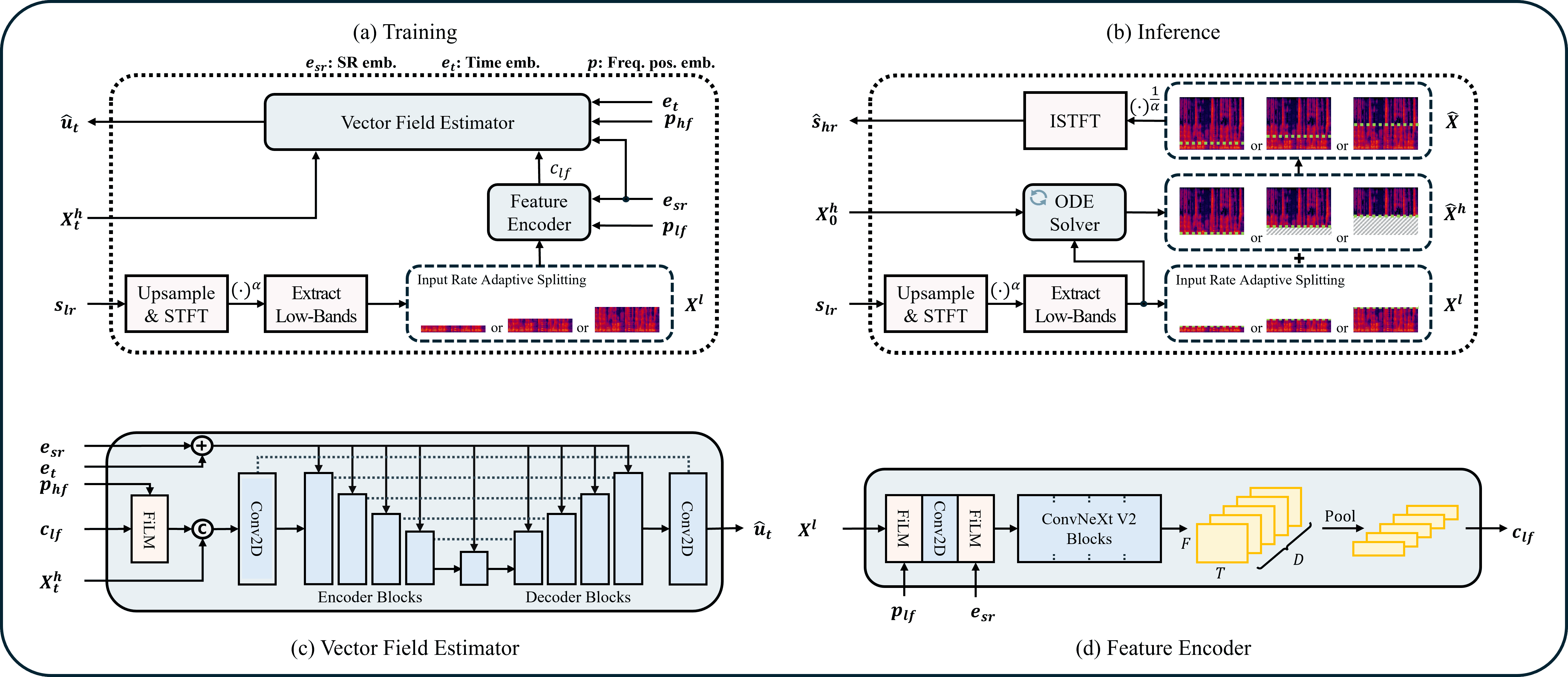
ComfyUI nodes for **[UniverSR](https://github.com/woongzip1/UniverSR)** — *Unified and Versatile
|
||
Audio Super-Resolution via Vocoder-Free Flow Matching* (ICASSP 2026,
|
||
[arXiv:2510.00771](https://arxiv.org/abs/2510.00771)).
|
||
|
||
A single model upscales **8 / 12 / 16 / 24 kHz** effective bandwidth → **48 kHz** across speech,
|
||
music and sound effects. It works directly in the complex‑STFT domain with flow matching — no neural
|
||
vocoder — and regenerates the missing high‑frequency band rather than just interpolating.
|
||
|
||
|
||
|
||
---
|
||
|
||
## Nodes
|
||
|
||
| Node | Output | Purpose |
|
||
|---|---|---|
|
||
| **UniverSR Model Loader** | `UNIVERSR_MODEL` | Loads + caches a checkpoint. Auto-downloads the presets to `models/universr/`. |
|
||
| **UniverSR Super-Resolution** | `AUDIO`, `IMAGE` | Runs the SR. Chunks long audio (click-free overlap-add). Optional before/after spectrogram. |
|
||
|
||
Wire it up:
|
||
|
||
```
|
||
LoadAudio ─────────────┐
|
||
▼
|
||
UniverSR Model Loader ─► UniverSR Super-Resolution ─► SaveAudio
|
||
└─ spectrogram ─► PreviewImage
|
||
```
|
||
|
||
### Model Loader
|
||
- **model** — `universr-audio` (general; music/SFX/mixed, recommended) or `universr-speech` (voice).
|
||
Each downloads ~230 MB to `models/universr/<name>` on first use. Local checkpoint folders placed
|
||
in `models/universr/` also appear in this list.
|
||
- **device** — `auto` / `cuda` / `cpu`.
|
||
- **local_path** *(optional)* — override with a folder (`config.yaml` + `pytorch_model.bin`) or a raw
|
||
`.pth`/`.ckpt` training checkpoint.
|
||
- **config_path** *(optional)* — `config.yaml` for a raw checkpoint. Empty → the bundled default config.
|
||
|
||
### Super-Resolution
|
||
- **input_sr** — the *effective bandwidth* of your content in Hz. The model treats everything up to
|
||
`input_sr/2` as valid and **regenerates above it**.
|
||
- `8000` → genuine low-rate audio (8 kHz → 48 kHz; the strongest, best-trained case).
|
||
- `16000` → brighten muffled but full-rate audio by regenerating only above 8 kHz (most natural).
|
||
- **ode_method** — `euler` (fastest) → `midpoint` (balanced) → `rk4` (best).
|
||
- **ode_steps** — flow-matching steps. `4` is fast and validated; `4–10` is a good range.
|
||
- **guidance_scale** — classifier-free guidance. Speech `1.0–1.5`, music `1.5–2.0`, SFX `~1.5`.
|
||
Higher = denser highs but less faithful. `0` disables CFG.
|
||
- **seed** — noise seed (`0` = random each run).
|
||
- **chunk_seconds** / **overlap_seconds** — long-audio handling (see below). `chunk_seconds=0`
|
||
processes the whole clip at once.
|
||
- **blend** — wet/dry mix. `1.0` = full SR. Lower keeps more of the original (handy for *bandwidth
|
||
extension* of already-48 kHz audio).
|
||
- **unload_model** — free VRAM after the run.
|
||
- **show_spectrogram** — also output a before/after spectrogram comparison `IMAGE`.
|
||
|
||
---
|
||
|
||
## Long audio & chunking
|
||
|
||
UniverSR runs the whole clip through a flow-matching ODE in one shot, which OOMs on long files
|
||
(the upstream notebook added chunking specifically to survive clips > 2 min). This node chunks in the
|
||
time domain and stitches the results with **overlap-add + linear crossfade** (weight-normalised), so
|
||
seams are click-free — an improvement over the upstream GUI's naive concatenation. Drop
|
||
`chunk_seconds` if you hit VRAM limits; raise `overlap_seconds` if you ever hear a seam. Stereo is
|
||
processed per-channel and preserved.
|
||
|
||
> Compared to the `FoleyTune BWE` node (which brightens short foley clips and processes the whole clip
|
||
> at once), this node adds the chunking needed for arbitrarily long sequences.
|
||
|
||
---
|
||
|
||
## Installation
|
||
|
||
```bash
|
||
cd ComfyUI/custom_nodes
|
||
git clone <this repo> ComfyUI-UniverSR
|
||
pip install -r ComfyUI-UniverSR/requirements.txt
|
||
```
|
||
|
||
The `universr` model code is **vendored** under `vendor/` (an installed `pip` copy is preferred if
|
||
present), so the only dependency beyond ComfyUI's stack is **`torchdiffeq`** (plus `einops`, `timm`,
|
||
`huggingface_hub`, `pyyaml`, which ComfyUI usually already has). Weights download automatically on
|
||
first use.
|
||
|
||
---
|
||
|
||
## How it works (implementation note)
|
||
|
||
ComfyUI audio arrives at an arbitrary real sample rate. UniverSR's *file* path relies on
|
||
`torchaudio.load` (fragile torchcodec backend), and its *tensor* path assumes the tensor is already at
|
||
`input_sr`. So this node does the band-limit itself: resample to 48 kHz → downsample each chunk to
|
||
`input_sr` (pure DSP, no codec) → hand UniverSR a genuine low-rate tensor to super-resolve. This
|
||
exactly reproduces the model's training-time degradation.
|
||
|
||
## Credits & license
|
||
|
||
UniverSR © Woongjib Choi et al., DSPAI Lab, Yonsei University — released under the MIT License
|
||
(see `LICENSE`). This node wrapper vendors the UniverSR inference code unmodified under `vendor/`.
|
||
|
||
```bibtex
|
||
@inproceedings{choi2026universr,
|
||
title = {{UniverSR}: Unified and Versatile Audio Super-Resolution via Vocoder-Free Flow Matching},
|
||
author = {Choi, Woongjib and Lee, Sangmin and Lim, Hyungseob and Kang, Hong-Goo},
|
||
booktitle = {IEEE ICASSP},
|
||
year = {2026}
|
||
}
|
||
```
|